Building an App? Here are the App Finance Trends Shaping the Industry in 2026
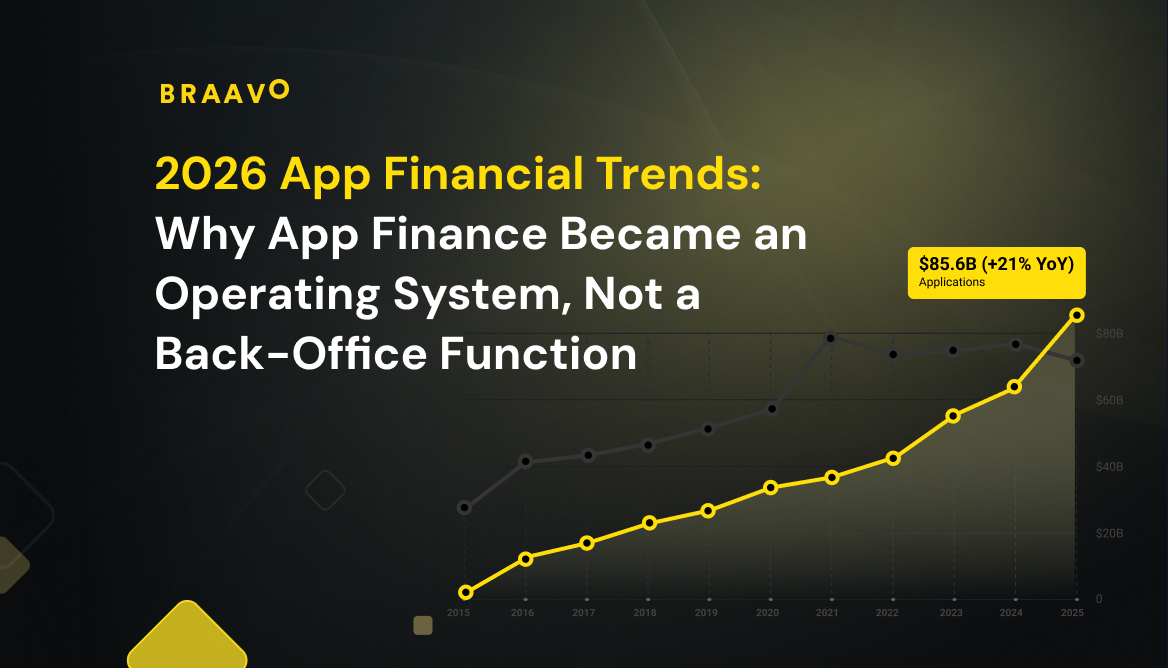
In 2026, running an app looks more like a cash flow exercise than building a brand. The strongest app businesses today are not just good at monetization, they are good at operating money: accelerating cash flow, funding growth at the right moment, and designing monetization systems that adapt in real time.
This shift is not theoretical. It’s visible in how apps monetize, how they fund user acquisition, how they manage payouts from platforms, and which financial products are gaining traction across the ecosystem.
Below is a deep look at the financial trends shaping app businesses in 2026—and what they mean in practice.
Monetization system over monetization strategy
Some of the biggest changes in app economics is not a new paywall format or pricing trick. It’s the disappearance of single-model monetization.
In 2026, most top-performing apps operate hybrid monetization systems that combine:
- subscriptions for predictable recurring revenue
- upsells, add-ons, and one-off purchases to boost LTV
- web payments (for web-to-app or web-to-web)
- and even affiliates to marketplace purchases
This shift reflects a mature market. Global app consumer spending continues to grow, but competition is intense and acquisition costs remain high. According to Sensor Tower, consumer subscription apps have overtaken games in terms of consumer spend, signaling a structural rebalancing toward subscription-led businesses. In 2025, non-gaming IAP revenue reached $85.6B (+21% YoY), surpassing games at $81.8B (+1% YoY) — marking the first time consumer apps have overtaken gaming in global consumer spend. Financially, this creates a paradox: revenue is more diversified and resilient, but forecasting becomes harder. The winners in 2026 are not the apps with the “perfect” monetization idea—they’re the ones with the infrastructure to test, segment, and iterate continuously.

This explains the central role of subscription and paywall platforms like RevenueCat, Adapty, and Superwall. These tools are no longer just analytics layers; they function as real-time revenue and monetization control systems.
Platform payouts still a growth bottleneck
One of the most under-emphasized financial constraints in mobile is the platform payout cycle.
In some months, the app stores takes over 60 days to pay developers for revenue earned. For example, a subscription payment on January 1st won’t be cashed out until early March. Meanwhile, user acquisition costs, salaries, and infrastructure bills are paid immediately.
Many high-performing apps are profitable on paper but capital-constrained in practice. They know where to invest—more UA, new geographies, better creatives—but can’t move fast enough because cash is stuck in payout pipelines. This is why liquidity products designed specifically for app businesses have moved into the mainstream.
Non-dilutive capital becomes an operating tool
Raising equity is no longer the default solution to short-term growth constraints. Founders increasingly view dilution as something to avoid unless it meaningfully changes the company’s trajectory. For consumer subscription apps…
At Braavo Capital, this demand shows up clearly across two core use cases:
- Earnings acceleration: factoring allows developers to access a large portion of earned revenue upfront, smoothing cash flow and eliminating growth pauses caused by app store payout delays.
- Growth financing: Braavo can fund user acquisition directly, with repayment tied to future revenue rather than fixed schedules or equity.
What matters is not just access to capital, but alignment. Financing that scales with performance reduces downside risk while preserving upside—something traditional loans and venture rounds were never designed to do.
Web payments and web2app flows reshape unit economics
Regulatory changes on the App Store and beyond have opened the door to alternative billing methods for mobile apps. But the financial impact goes far beyond compliance. In 2026, web payments are increasingly treated as a strategic lever:
- improving margins
- enabling channel flexibility
- reducing dependency on a single platform
At the same time, web payments introduce complexity: fraud, refunds, taxes, customer support, and attribution challenges. This is why web2app strategies are not simply “growth hacks”—they require expert-level execution, tooling, and capital to scale properly.
Web publishing platforms like Great Apps reflect this convergence, combining infrastructure and growth execution to make web monetization operational rather than experimental.
The new reality: app finance is part of product strategy
For the app industry, 2026 makes it clear that financial decisions can no longer be postponed until “later.” Monetization design, payout timing, capital structure, and growth funding now shape:
- how fast an app can iterate
- how aggressively it can scale
- how resilient it is during market shocks
The most successful teams treat finance as part of their product: they optimize revenue flow the same way they optimize onboarding or retention.
What app teams should do next
For app operators planning 2026 and beyond, a few actions stand out:
- Map your cash-flow reality, not just your revenue: Understand where growth slows because cash arrives too late.
- Build monetization for flexibility: Hybrid models outperform single-stream bets in volatile markets.
- Choose capital that matches your economics: Liquidity tools for timing problems, growth capital for scaling problems—without unnecessary dilution.
- Treat finance as infrastructure: The same way analytics and experimentation became non-negotiable, financial tooling is now part of the core stack.
Final thought
The apps that win in 2026 won’t just monetize better. They’ll move money faster, deploy it smarter, and keep ownership intact. That’s not just good finance, it’s a competitive advantage.
2026 is the year to level up your cash flow game. Is your app ready? See how Braavo can help.
Related posts

How Coffee Meets Bagel Bridged Equity Rounds and Became Profitable With Funding From Braavo
Coffee Meets Bagel (CMB) is the well-known “anti-swipe” dating app, where over 90% of users are looking for serious relationships. Since its launch in 2012, CMB has made over 150…

Why Your App Marketing Strategy Should Include a Web Acquisition Funnel
Eugene Strelets is a mobile growth and product manager with over four years of experience in data-driven experimentation. With a deep focus on driving mobile products to the next level…

9 App Growth Strategies and the Benefits of Working With an App Marketing Agency
Fouad Saeidi made his start in mobile marketing over 10 years ago, back when the App Store was still new and mobile marketing best practices were in their infancy. “The…
