Why Consumer App Founders Should Be Prepared For Q5
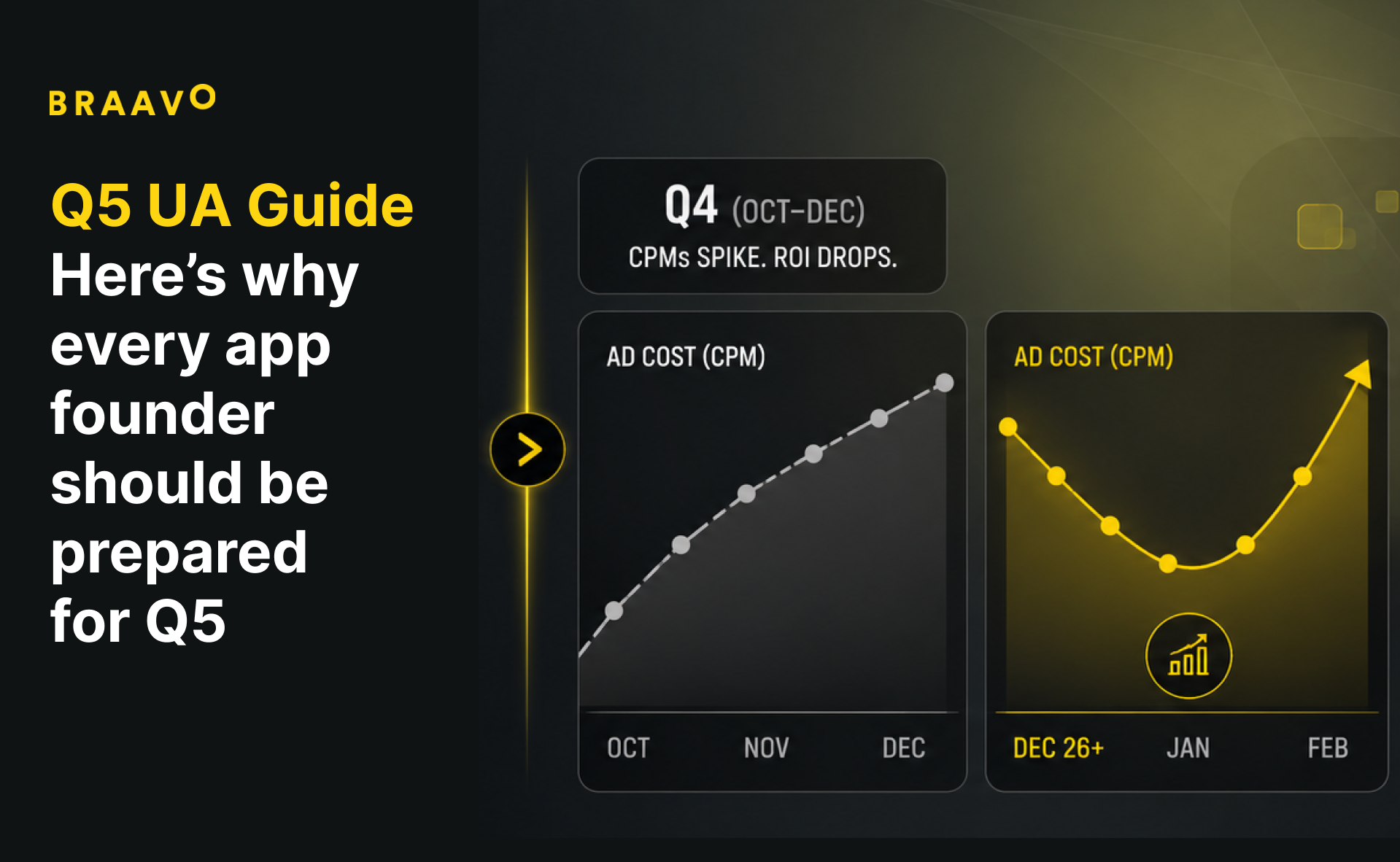
Every app founder knows Q4. You brace for CPMs to spike, you fight the algorithm against every other DTC brand trying to cash in on multiple major holidays, and your ROI drops. Budgets get pulled, creative testing slows, and UA performance stalls for weeks.
Then Christmas hits, and everything changes. The two to six weeks right after Christmas, known in the app industry as Q5, is one of the most important, highest-intent windows of the entire year.
If you’re an app founder unprepared for Q5, you’re making a big mistake.
What is Q5, exactly?
Q5 is the “hidden quarter”: it’s the stretch from around December 26 through mid-to-late January (some marketers push the window out to early February) that doesn’t belong to any of the traditional four quarters.
Here’s why it exists: CPMs spike hard through Q4 as every DTC brand on the planet fights for holiday attention, then drop off a cliff the moment Christmas is over. Ad demand falls, but user attention doesn’t — people are on their phones more than usual, sitting on gift cards, and heading into a new year already primed to make a change.
Lower cost, higher intent. That combination is Q5.
It’s not a fringe theory anymore, either. Meta, TikTok, and AppsFlyer have all put out dedicated Q5 playbooks for app marketers in the last year. It’s become a real line item in UA teams’ planning, not just a blog post concept.
Does Q5 only matter for paid UA?
No, and this is where a lot of teams leave money on the table. Q5 shows up in three places at once:
- Paid UA. This is the obvious one. Lower CPMs and CPAs mean your existing creative — the stuff that was barely profitable in November — can suddenly clear your target ROAS with room to spare.
- UGC and organic. Q5 is prime “new year, new me” territory. Audiences are actively looking for content about starting fresh, building better habits, and fixing whatever they’ve been putting off — which is exactly the emotional register UGC creators are built to hit on. A resolution-themed UGC batch shot in early December and held for a Q5 release will consistently outperform generic always-on content, because it’s speaking to where the user’s head already is.
- Re-engagement. Don’t sleep on this one. You spent Q4 acquiring a pile of new users at premium CPMs. A chunk of them installed, poked around, and went dormant over the holidays. Q5 is the moment to win them back before they forget why they downloaded you in the first place — win-back campaigns and push sequences timed to early January routinely outperform anything you’d run in a normal month.
Which categories get hit hardest in Q5 (in the best way)
Q5 isn’t evenly distributed. It disproportionately favors app categories tied to resolutions and post-holiday behavior:
- Health & fitness: the obvious one, but still the biggest lift of the year for a reason
- Finance & budgeting: post-holiday spending regret is real and it converts
- Productivity: “this is the year I get organized” has a very specific seasonal peak
- Education & learning: new year, new skill
- Shopping/retail: gift card redemption season, plus consumers who are still in a spending mindset
If your app lives in one of these categories, Q5 isn’t a nice-to-have. It’s arguably your single best growth window of the year.
Prepping for Q5 starts as early as Q3 — not January 2nd
The single biggest failure mode: waiting until December or January to “figure out Q5.” By then the cheap CPMs are already weeks old and you’re building creative from scratch instead of deploying.
What actually works:
- Plan and shoot resolution-themed creative in November/early December, before your team gets swallowed by Q4 execution. Have it sitting in the vault, ready to go the second Christmas Day hits.
- Set your budget shift in advance. Decide now how much Q4 spend you’re going to pull forward or hold back so you’re ready the moment CPMs drop.
- Build your re-engagement flows before the users go dormant. Segment your Q4 cohort and have the win-back sequence built and scheduled.
- Localize if you’re global. Q5 timing shifts even by market (ie. the Lunar New Year follows a different calendar than North America). Plan for that instead of applying one global playbook.
The teams that win Q5 aren’t the ones with the best budgets. They’re the ones who did the prep work earlier in the year while everyone else was heads-down on Black Friday.
Why capital timing is the key to success in Q5
Q4 is expensive. You’re already spending aggressively to compete for holiday attention, and that spend ties up cash right when you need it most — the moment CPMs drop and the ROI math flips in your favor. If your budget is fully committed to Q4 and you’re waiting on January revenue to reload, you’re going to watch the cheapest, highest-intent acquisition window of the year pass you by while you wait for cash to clear.
This is exactly the kind of timing mismatch non-dilutive capital exists to solve. Revenue-based financing lets you pull forward capital against your own recurring revenue today, so you can walk into Q5 with a loaded budget instead of an empty one. You’ve already earned the revenue; the only question is whether you can access it on the calendar that matches your growth window instead of your bank account’s.
Revenue-based financing lets you pull forward capital against your own recurring revenue today, so you can walk into Q5 with a loaded budget instead of an empty one.
The founders who treat Q5 as a real growth quarter are the ones who go into it with capital already lined up. The rest are stuck rebuilding their war chest in January, right as the window they should be capitalizing on starts to close.
Braavo provides non-dilutive, revenue-based financing for app founders, so you can fund your next growth window without giving up equity or waiting on your own cash flow to catch up. Sign up here to learn more
Related posts
How Lovi Used UA Cohort Financing to Triple Ad Spend Without Tying Up Equity
Lovi had already built the growth engine. Braavo helped give it more room to run. The AI skincare app had grown rapidly on the back of web2app acquisition, turning paid…
Braavo x Snapchat: A New Growth Opportunity for App Founders
Here’s how one Braavo customer is building one of its most profitable marketing channels on Snap. Sociaaal, the Gen Z-focused app studio behind a 20-app portfolio and 34M+ downloads, has…
Building an app? Here are the app finance trends shaping the industry in 2026
In 2026, running an app looks more like a cash flow exercise than building a brand. The strongest app businesses today are not just good at monetization, they are good…
