How a Two Person Team Scaled their Charisma Coaching App 400% in 6 Months
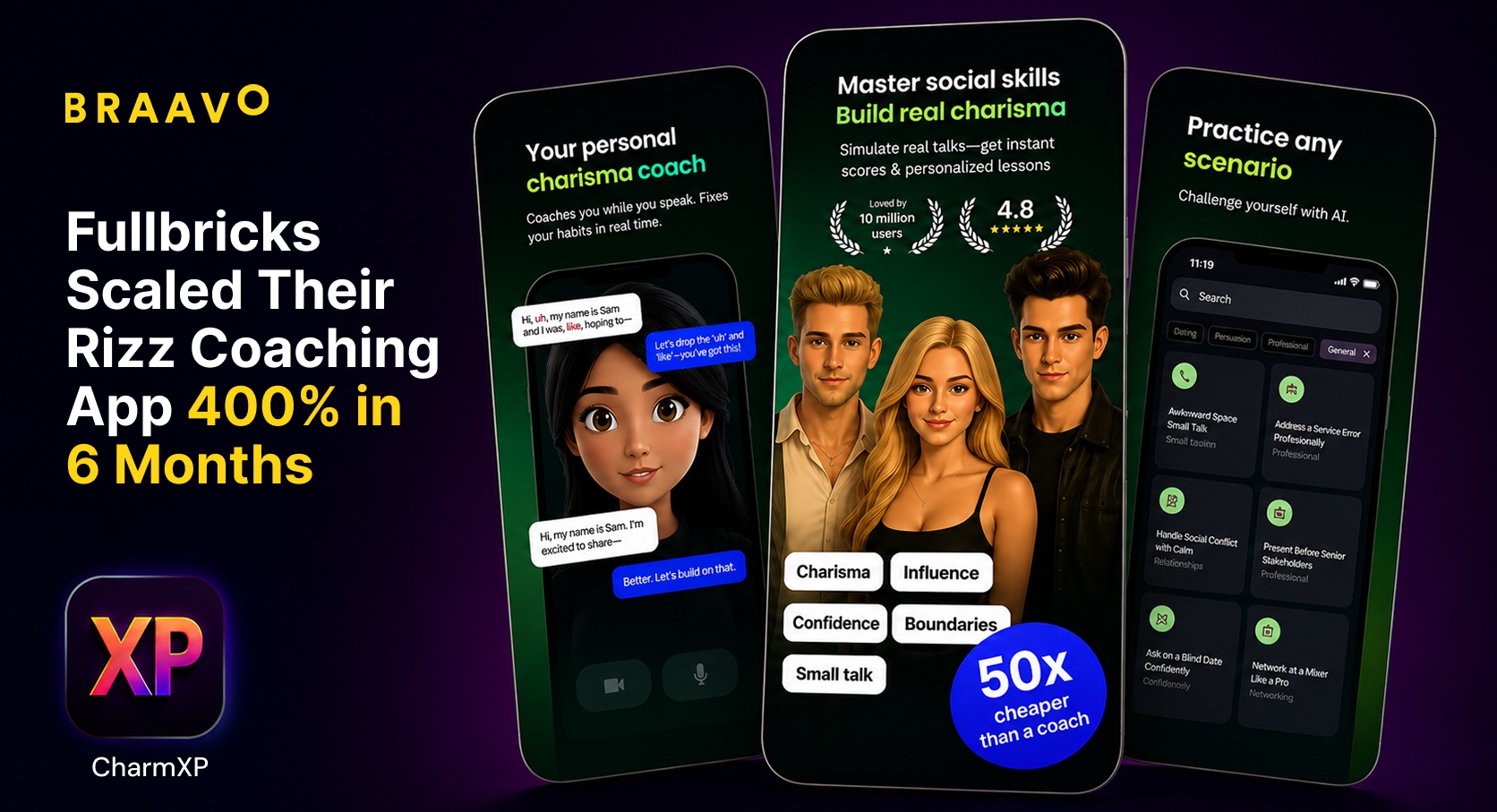
Fullbricks is the two-person team behind CharmXP, an AI-powered social skills coaching app that helps users build real-world charisma through voice-based roleplays, personalized feedback, and gamified daily practice. Less than a year from launching on the App Store in June 2025, they’ve scaled fast, cracking 400% growth in the last 6 months. But the co-founders didn’t take equity to get there, and they didn’t slow down to wait for App Store payouts. Instead, they built a compounding growth engine and kept feeding it. Here’s their story.
The First Bet: Influencers Before Paid
Most app founders with a performance marketing background go straight to Meta ads. Sam and Hassaan didn’t, at least not initially.
“With paid ads, it’s a cash flow game,” Sam explained. “At the time we weren’t working with Braavo, so we needed to find a cheaper way to get reach. That’s why we tested influencers first.”
They quickly learned what messaging resonated, which audience segments engaged, and what kind of content made people actually stop scrolling. “Starting out with influencers gave us a good perspective on what the audience wanted,” Hassaan said. “That enabled us to unlock more channels, more ICPs, and figure out how we wanted to take the product to the next step.”
From there, they moved to organic content, different angles, and relentless testing. And when they finally moved to paid UA, they were ready.
The Cash Flow Problem
Within a few months of launching on Meta, they had a clear read on what was working. But the problem Sam and Hassaan faced was momentum: every dollar they put into paid ads had to run its full Apple payout cycle before they could reinvest it.
“It’s a capital game,” Sam said. “If you can speed up your cash flow cycle, you have more money to test and iterate faster.”
They looked at their options: one alternative lender was focused on publishers and ad networks. “But they didn’t really understand the business model as much as Braavo did,” Sam told me. “When Braavo told us about all the apps they work with, we thought, these guys actually understand our pain points. That’s what you’re looking for in a partner.”
Fullbricks signed with Braavo in late 2025. Since then, they’ve consistently used their App Store payouts to fund Meta ads, accelerating the cycle that was previously the bottleneck.
Braavo actually understands our pain points. That’s what you’re looking for in a partner.
“Now, whatever we’re investing, we’re seeing our returns, we’re investing it right back, and we’re compounding as we go,” Hassaan said.
The Framework: Profit Centers
The thing that struck me most about how Sam and Hassaan operate isn’t any single channel or tactic. It’s how they think about capital allocation.
They call it “profit centers”: each distribution channel — paid ads, organic, influencers — is treated as an independent unit. Each one gets measured on its own unit economics: CPA, ROAS, LTV by customer segment. Like true performance marketers, they move capital into what’s working. “We look at the unit economics of each one of these channels,” Sam said. “We make sure our capital is being spent efficiently across what’s actually making money.”
Knowing Your Numbers Before Scaling
Unsurprisingly, Hassaan came from five years running a performance marketing agency. Before scaling anything, he had a deeply ingrained framework for what “working” actually looks like.
“We really have our numbers dialed down,” he told me. “We know what works. We’re able to test very quickly. Top of funnel: we publish ads, we look at our CPC, our CTR, and we can tell if a creative is going to work without spending a lot to find out.”
Whatever we’re investing, we’re seeing our returns, we’re investing it right back, and we’re compounding as we go.
This is what allowed them to iterate aggressively without burning cash on tests that dragged on too long. “A little bit of spend can get us a lot of information, because at the end of the day, we’re buying data.”
Fullbricks is now getting started on UGC, a channel they’ve deliberately held off on until their paid attribution was tight enough to measure its impact accurately. “We have ways to attribute organic uplift to a good confidence level,” Sam said. “That’s why we’re getting into UGC now, because we have the right mix to make sure we’re getting an ROI there too.”
The Toronto Factor
Sam and Hassaan are based in Toronto, Canada, and both are candid about the challenges of building consumer apps there. Dry consumer investor ecosystem. Five big banks with no competitive pressure to take risks. A culture, as Sam put it, that tends to treat entrepreneurship like unemployment.
But there’s a flip side: Hassaan pointed to a small but serious community of consumer app founders who are genuinely world-class, including the teams behind Sprout and Halo AI, both of whom have influenced how UGC and app growth is done across North America.
“The consumer app scene here is really underground,” Hassaan said about Toronto. “But the people who are in it are really smart.”
The Takeaway
Fullbricks didn’t need to pick between growth and control. They found a capital structure that let them move like a well-funded company while staying cash flow positive and profitable. They kept their equity, while investing in compounding performance while momentum was on their side.
For app founders who are growing or scaling paid UA and waiting weeks for App Store payouts to recycle back in, that delay is friction. Removing it changes your growth trajectory entirely. Join our portfolio.
Related posts
How FivePointFive Is Redefining Breathwork for Athletes, and Growing 50% MoM
For more than a decade, breathwork has largely been packaged in a single, gentle aesthetic: soft voices, ambient soundscapes, and passive meditation. Those experiences helped bring mindfulness to the mainstream,…
On-Demand Payouts: How This Microlearning App Scaled with Braavo
The Company Yuno is a Berlin-based micro-learning app that uses AI-powered storytelling and human expertise to turn broad, high-quality knowledge into a daily habit for millions of users. While the…
How Coffee Meets Bagel Bridged Equity Rounds and Became Profitable With Funding From Braavo
Coffee Meets Bagel (CMB) is the well-known “anti-swipe” dating app, where over 90% of users are looking for serious relationships. Since its launch in 2012, CMB has made over 150…
