From $0 to $1M: The Organic Growth Playbook Behind Pushscroll
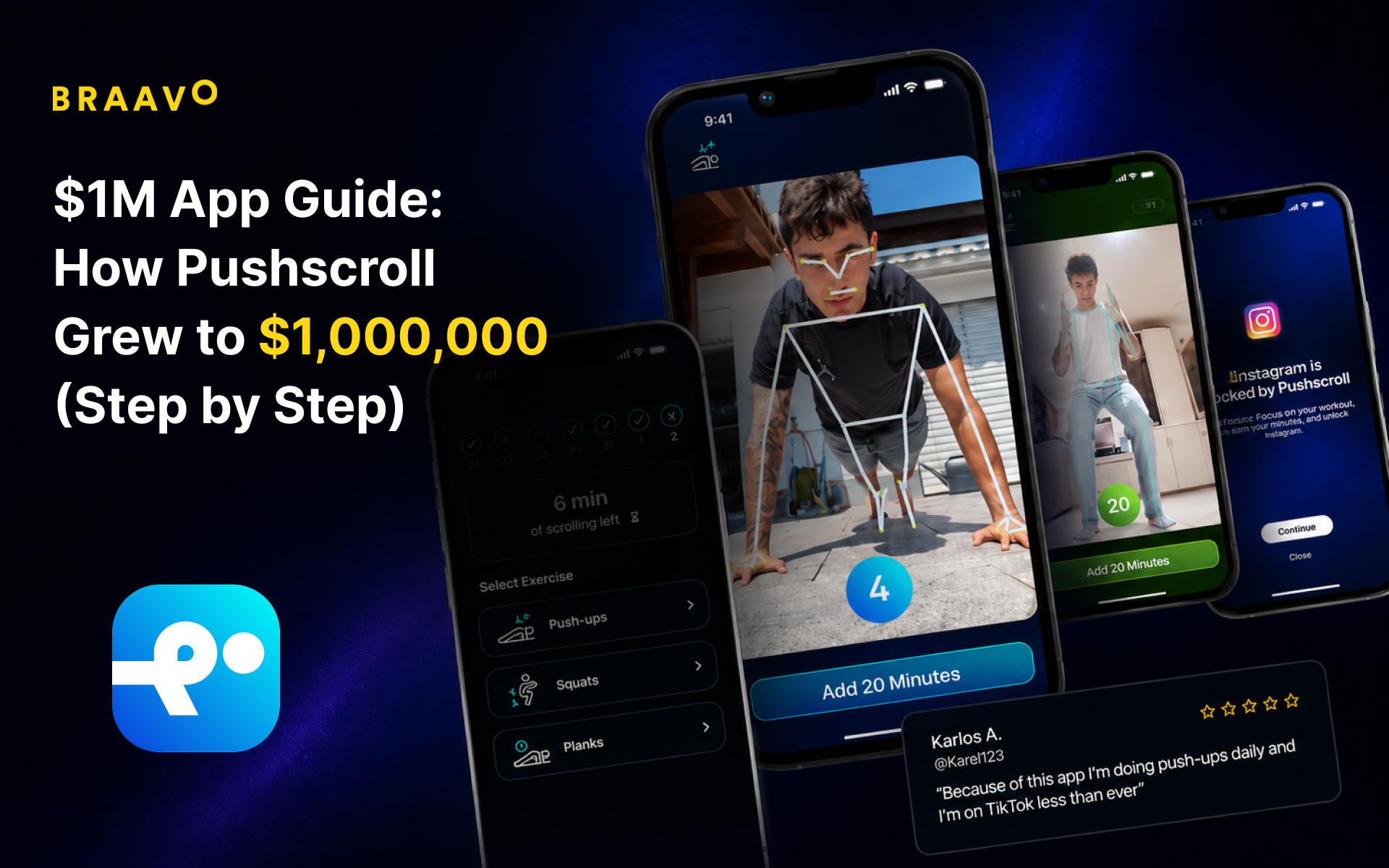
Over the course of one year, Braavo portfolio company Pushscroll generated more than $1 million in total iOS and Android proceeds. Its users completed more than 28 million push-ups through the app, turning a simple screen-time concept into a viral product with a highly engaged user base.
Pushscroll was built by Alejandro Sanchez, founder of the original “Push-Ups Before Scrolling” app. In this article, we break down the exact marketing approach Alejandro used to start with almost no budget and scale the product to approximately $100,000 in monthly recurring revenue.
The contents of this article originally appeared on X and was republished with permission from the author.
The First $5,000 Went to Influencers—and It Didn’t Work
At the beginning, the Pushscroll team believed influencer marketing would be the best way to grow the app. They invested the first $5,000 they had saved into influencer campaigns. The assumption was simple: influencers already had audiences, so paying them to promote the product should generate users. In reality, influencer marketing proved much more difficult to get right. A campaign can fail completely, especially when a team does not yet have enough experience identifying the right creators, negotiating collaborations, or predicting how a creator’s audience will respond to the product.
Companies such as Cal AI made influencer marketing look relatively straightforward. But for an early-stage app with a limited budget, many influencer partnerships can turn out to be ineffective. Alejandro does not recommend starting directly with influencers when the marketing budget is tight. Founders need to be prepared for the possibility that an influencer campaign will produce almost no results. That was exactly what happened to Pushscroll. However, losing the initial budget became a blessing in disguise. With no money left for external creators, the team had to start producing its own organic videos. That decision changed the trajectory of the company.
Step 1: Start With a Viral App Idea
According to Alejandro, if an app idea is not naturally viral, this is one of the first things the founder should reconsider. For teams that have not built an app yet, virality should be considered during the idea stage—not after the product has already been developed. A viral concept can make marketing significantly easier. Even making an idea 5% more shareable, visual, surprising, or understandable can have a major impact on the entire business.
For Alejandro, the virality of the app idea is one of the most consequential decisions a founder can make. A viral app concept usually has three important characteristics.
A. Make It Visual
Can someone understand the value proposition of the app from one or two visuals? For Cal AI, the visual is a user taking a picture of their food.

For UMax, it was scanning a person’s face and showing their “looksmaxxing” statistics.
For Pushscroll, it is the combination of a push-up tracker and an app-blocking screen.

The value proposition should be understandable before the viewer reads a long explanation or listens to a voice-over. This is particularly important on TikTok and Instagram, where users make almost immediate decisions about whether to continue watching or scroll to the next video. That does not mean the app itself has to be extremely simple. The product can be sophisticated behind the scenes. But the core idea needs to click visually.
B. Make It Novel
The second major factor is novelty. Alejandro does not recommend copying another app pixel for pixel. Instead, founders should take a concept that already works and find a new angle on it. A novel variation can create an initial two- or three-month boost on platforms such as Instagram. That novelty window can be extremely valuable during an app’s early growth stage.
When Pushscroll began publishing videos, there was only one major competitor producing content around a similar concept. Even then, there were not many strong videos explaining the idea. This gave Pushscroll significant room to benefit from novelty. Today, apps that directly copy Pushscroll often do not achieve the same initial success because audiences have already seen the concept. The novelty factor has weakened.
The goal is to find a variation that makes viewers think: “I’ve never seen this before. Let me watch a little longer.”
C. Build It Quickly
The novelty window closes fast. When an idea takes six months and $15,000 in development costs to launch, another team may release a similar product first and capture the initial wave of attention. Alejandro recommends using AI tools that help teams build from idea to product quickly, emphasizing that when the product depends on novelty, speed matters. He says that founders need to build and validate the idea before the window closes.
Step 2: Learn the Blueprint of Virality
When people see a simple talking-head video receiving millions of views, they may assume that creating viral content cannot be particularly difficult. What they do not see is the skill behind the script, delivery, pacing, editing, watch time, and skip rate. When successful videos are broken down carefully, it becomes clear that creators use a wide range of techniques to keep viewers watching.
Alejandro recommends studying creators who specialize in virality and short-form content, including:
- Mino Lee
- Ken Tjandra
- Personal Brand Launch by Ava
This was also how he started learning. Studying high-performing creators teaches more than scriptwriting. It also helps founders become more confident on camera—a skill that usually needs to be developed through repetition.
Alejandro was not naturally comfortable on camera when he began. His early videos had less energy and a less engaging delivery. Over time, the difference became significant. His central recommendation is simple: bring energy to the video. Do not sound bored or disconnected from the subject.
Below are the most important principles Alejandro learned.
A. Create a Strong Hook
The first step is developing a strong hook. On platforms such as Instagram, the effectiveness of the hook can be measured through the skip rate: the percentage of people who leave within the first three seconds.
According to Alejandro’s experience:
- A weak hook may have a skip rate above 50%. These videos usually struggle in organic distribution, although some may still work as paid ads.
- An exceptionally strong hook may have a skip rate below 18%. These videos have a much greater chance of going viral.

Several elements contribute to a strong hook.
- Create a Curiosity Gap: The viewer needs a reason to continue watching.
For Pushscroll, the curiosity comes from the possibility that an app could actually help someone stop a doomscrolling addiction. The push-ups also appear unexpected and slightly out of place, creating another reason to keep watching.
- Make It Novel and Original: The concept should feel different from what the viewer has already seen.
Pushscroll’s videos benefited because the app idea itself was relatively new.
- Establish Perceived Trust: The viewer should believe that the video will eventually deliver what the hook promises.
A dramatic hook may attract attention, but people will leave quickly if they sense that the creator cannot support the claim.
- Use Emotion: Certain words create a stronger emotional response than neutral language.
For example, Alejandro sometimes uses the phrase “doomscrolling addiction.” Both words carry emotional weight and clearly communicate the problem.
- Keep the Language Clear: The hook should be concise and easy to understand.
Alejandro recommends using language at approximately a fifth-grade reading level and removing every unnecessary word.
- Consider Making It Persona-Specific: A hook can also target a very specific type of viewer.
For example: “As a broke, unemployed 24-year-old college student…” Instagram’s recommendation system can be surprisingly effective at finding people who identify with that exact persona.
- Support the Hook Visually: A strong spoken hook becomes even more effective when it is supported by an interesting visual.
For example, Alejandro could introduce Pushscroll while already doing push-ups. For teams that are just starting, he recommends adapting hooks that have already demonstrated strong performance. One way to identify them is to study videos with at least 50,000 likes.
B. Increase Watch Time
A strong hook is only the beginning. The video must continue giving the viewer reasons to stay.
- Create Mini Curiosity Gaps
Do not use curiosity only in the opening sentence. Introduce smaller open loops throughout the video. A phrase such as “I’ll explain why that mattered in a second” can keep viewers from scrolling because they are waiting for the answer.
- Save the Strongest Point for Later
In list-based or step-by-step videos, the best insight should not always appear first. Viewers continue watching when they believe something even more valuable is coming. When the third point is significantly weaker than the first two, people may feel disappointed and leave before the end. That damages the completion rate.
- Use Past Continuous Tense When Telling Stories
Compare these two examples: “I went to the mall and saw something scary.” and “I was driving to the mall when I saw a blurry figure.” The second version places the viewer inside the moment rather than summarizing the event from a distance. Summaries often reduce tension. Active storytelling helps maintain attention.
- Use Specific Examples
Specificity gives the viewer something concrete to process. Names, numbers, dates, situations, and exact emotions are usually more engaging than general claims. For example: “Two months ago, I lost 34 kilograms.” This is more attention-grabbing than simply saying: “I lost a lot of weight.”
Vague statements give the brain very little to hold onto. Specific details force attention.
- Match Sound to the Emotional Tone
Music and sound should support the emotion of the section. A mismatched soundtrack can break the viewer’s immersion. For example, aggressive drums underneath a serious or emotional story may feel unnatural. Most short videos contain only one meaningful tonal shift. Creators should not force several music changes simply because rapid editing is fashionable.
- End With a Practical Takeaway
People are more likely to rewatch a video when they leave with one clear action to take. Rewatches can strengthen distribution because they signal that the content was useful or difficult to absorb in a single viewing. A practical takeaway is usually stronger than vague motivation.
- Remove Anything That Is Not Necessary
Speed creates perceived value. Every sentence needs to earn its place. If a phrase feels repetitive, it should be removed. Every second saved is one less second in which the viewer can leave.
- Use B-Roll
B-roll matters more than many founders expect. Even ten seconds of B-roll during the first 30 seconds gives the viewer’s eyes something new to process. This can reset attention before the point at which many videos experience a mid-video drop-off.
Step 3: Copy, Paste, and Adapt
The previous techniques work best when the creator already has a strong baseline. Alejandro recommends researching competitors and creators in the same niche. When a video has at least 50,000 likes, its hook, structure, or format may be worth adapting. The important word is adapting. Creators should never copy another video pixel for pixel. Instagram tends to reward novelty inside formats that have already been proven.
Alejandro’s process looks like this:
- Follow approximately ten creators or competitors in the niche.
- Search for keywords connected to the product.
- Watch relevant videos in full.
- Record which topics and formats are receiving strong engagement.
- Build new content ideas around those patterns.
- Study the pain points that other creators mention.
- Adapt successful competitor videos to the app’s own positioning.
For Pushscroll, useful keywords included “doomscrolling” and “screen time.” The pain points discussed by other creators are often the same pain points potential users already experience. This makes competitor content a valuable source of customer research. Direct competitors can be especially useful. When they have already produced viral videos, they may have effectively validated several hooks or formats that another company can reinterpret.
Alejandro also recommends spending time on the platform’s For You Page and fully watching content within the target niche. A founder’s default social feed mostly reflects their own interests. It may not accurately represent what the customer is seeing.
Finally, once a format begins working, repeat it. A successful content format should continue being used until the performance declines. There is no need to abandon a winning structure simply because it has already been posted once.

Step 4: Get Views That Convert
High view counts do not automatically create a successful app business. Alejandro illustrates this with the example of a Pushscroll competitor. The competitor uses an extremely attention-grabbing format that demonstrates the product very quickly and in a deliberately rushed way. The videos regularly receive more than one million views, while the most successful reached approximately 50 million.
However, despite generating an estimated 40 million monthly views, Alejandro estimates that the app produces only around $6,000 in MRR.
That format may be useful for warming up an account or generating visibility. But it is less useful for a company that wants to scale revenue rather than collect vanity metrics. The format is also unlikely to work well in Meta advertising. The Pushscroll team tested similar approaches repeatedly without achieving the desired results. Some marketers may classify this content as effective UGC. However, Alejandro is skeptical about reaction-based UGC and rushed demonstrations that contain very little substance.
TikTok has also been restricting many UGC accounts, making low-effort, high-volume content less reliable as a long-term strategy.
The central problem is that views do not necessarily equal high-intent users.
When evaluating a video, teams should not look only at view count. They should also examine:
- Comments
- Shares
- Saves
- Install increases
- New-user spikes
- Subscription growth
- Revenue generated by new customers
The most important question is not: “How many views did this video receive?”
It is: “How much money did this video generate from new subscriptions?”
How to Create a High-Converting Format
Alejandro’s recommendation is to avoid relying exclusively on text-based videos.
Creators should speak directly to the audience, put meaningful effort into production, and clearly present the product’s value proposition within the first ten seconds—ideally within the first seven.
The video should combine:
- High-retention editing
- Pattern interrupts
- Changes in rhythm or emotional tone
- Clear product demonstrations
- Strong storytelling
- A visible and understandable value proposition
Alejandro points to creator Denis Han as an example of this approach. One of Denis’s videos reportedly generated more than 200,000 users from approximately eight million views.
Pushscroll also produced a video that brought in roughly 200,000 new users.
The lesson is not that every video needs millions of views. It is that content should be designed to attract the right viewers and move them toward the product.
Bonus: Engagement Hacking With Automated DMs
One tactic that significantly helped Pushscroll was Manychat. Manychat allows a business to send an automated direct message when someone comments on an Instagram video.
For example, a creator can ask viewers to comment “App” to receive the download link automatically. According to Alejandro, this worked for three main reasons.
1. Comments Create Participation
When people see hundreds or thousands of others commenting “App,” they are more likely to join. One Pushscroll video reportedly generated around 200,000 comments containing the word “App.” Because each person received the product link, these comments became a direct distribution channel.
2. Comments Increase Social Proof
A large number of comments makes the product appear more relevant and popular. It may also attract attention from creators and influencers who discover the post organically.
3. Engagement Expands Distribution
Instagram sees the high volume of comments as a strong engagement signal. As a result, the platform may distribute the video to more people, creating an additional growth loop. The comments produce direct messages, the direct messages produce installs, and the increased engagement produces more views.

The Main Lessons From Pushscroll’s Growth
The app itself needs to be easy to understand, visually distinctive, and novel enough to interrupt the user’s feed.
The content then needs to do several jobs at once:
- Capture attention immediately
- Create curiosity
- Demonstrate the product
- Maintain watch time
- Speak to a recognizable pain point
- Attract users with genuine intent
- Move viewers toward an install or subscription
For app founders, the broader takeaway is clear: distribution should not be treated as something that begins after the product is finished. Virality starts with the product idea itself: the concept, visual presentation, development speed, content format, and conversion path all need to work together.
A viral video can create attention. A viral product with a high-converting content system can create a business.
Are you an app founder ready to go viral? Become financially prepared to scale like Pushscroll with funding from Braavo Capital. Learn more.
Related posts
Launched, Scaled, Sold: The 12-Month Story of Overcomer
Key Takeaways Your only moat is distribution: Copycats will come, but anyone can clone an app. No one can clone your exact marketing strategy or creator program. Growth capital works…
How Unrot Bootstrapped to 1M+ Downloads
Most founders dream of the kind of problem Unrot experienced just two months after launching: meta ads that worked too well. Unrot launched in June 2025 with a simple goal.…
How This Two-Person Team Scaled Their AI Social Skills App 400% in 6 Months
Fullbricks is the two-person team behind CharmXP, an AI-powered social skills coaching app that helps users build real-world charisma through voice-based roleplays, personalized feedback, and gamified daily practice. Less than…
